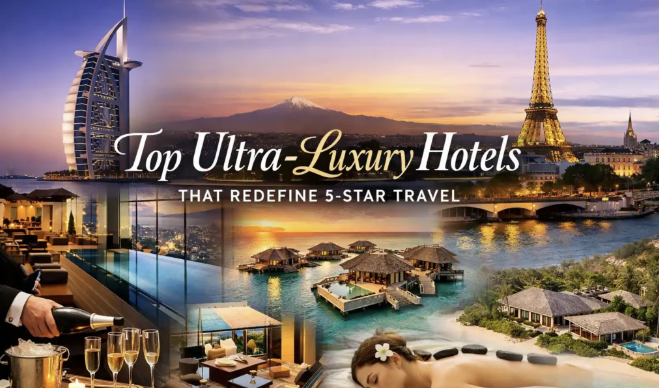
Top Ultra-Luxury Hotels That Redefine 5-Star Travel
Why Ultra-Luxury Hotels Matter More Than Ever in Premium Travel
Top Ultra-Luxury Hotels is not playing by the old rulebook anymore. A marble lobby, a branded bathrobe, and a polished check-in desk are no longer enough to impress global premium travelers who can book a private island one week and a skyline penthouse the next. What they want now is something far more difficult to engineer: precision hospitality. They want the kind of stay that feels less like a transaction and more like a perfectly choreographed world built around their habits, their pace, their privacy, and their standards. That shift is visible across current travel research.
American Express reports that 77% of global respondents plan to take more or the same number of international trips in 2025, while 66% say combining credit card rewards with loyalty perks delivers the best value for international trips. Visa’s 2025 affluent traveler research adds another sharp signal: households earning over $200,000 are helping drive up to a quarter of all travel spending globally, and they increasingly expect personalization, authenticity, convenience, and data-driven service. In other words, the new luxury traveler is not simply buying a room; they are buying time, access, calm, and confidence.
What Separates Ultra-Luxury From Ordinary Five-Star Hospitality
The difference between a good five-star hotel and a truly ultra-luxury one is a bit like the difference between owning a beautiful watch and owning a watch made specifically for your wrist, routine, and taste. Both tell time. Only one feels personal before you even fasten it. Ordinary upscale hospitality tends to focus on visible signals: larger rooms, better linens, higher-end finishes, a respectable spa, maybe a Michelin-adjacent restaurant. Ultra-luxury goes deeper. It is built around friction removal. You never feel rushed, managed, or processed. Transport is seamless. Preferences appear to have been remembered before you state them.
Dining can flex around your schedule. Security is discreet. The room is less a room than a private environment calibrated for sleep quality, wellness, beauty, entertaining, and quiet work. This matters even more now because affluent travelers are making choices with greater intentionality. Visa notes that high-income travelers are moving toward unique, immersive experiences and often toward less predictable destinations, while American Express shows travelers increasingly linking trips to meaningful experiences, local discovery, and reward optimization. Ultra-luxury hotels win because they support all of that without making the guest do the heavy lifting.
The Hotels Setting The New Global Benchmark
Before diving into each property, it helps to see how these standout hotels compare at a glance.
| Hotel | Destination | Standout premium feature | Why it redefines luxury |
|---|---|---|---|
| Burj Al Arab Jumeirah | Dubai | Duplex suites and butler-led service | Turns hotel staying into theatrical VIP hospitality |
| Aman Tokyo | Tokyo | 30-metre pool, onsen-style wellness, skyline serenity | Proves urban luxury can feel meditative |
| Cheval Blanc Paris | Paris | 72 rooms and suites, Dior Spa, intimate Parisian setting | Makes privacy and craftsmanship feel rarer than scale |
| Soneva Jani | Maldives | 5.6-km lagoon, low-density villas, retractable-roof overwater stays | Blends spectacle with seclusion and experiential design |
| The Lana | Dubai | Dior Spa and large skyline-facing suites with terraces | Represents next-generation city luxury |
| The Brando | French Polynesia | 35 private villas on Tetiaroa | Delivers secluded eco-luxury with true island exclusivity |
Burj Al Arab Jumeirah, Dubai
Some hotels are luxurious. Some hotels are symbols. Burj Al Arab Jumeirah remains one of the rare properties that still does both without losing cultural relevance. In a market crowded with new towers, branded residences, and ultra-premium openings, this hotel continues to attract international luxury travelers because it understands the power of drama. Its accommodation offering centers on duplex suites, described by Jumeirah as palatial spaces spread across two floors and connected by grand staircases.
That layout alone changes the psychology of the stay. You are not just sleeping in a high-end room; you are inhabiting a vertical private residence with ceremonial flair. This is the sort of property that works especially well for travelers who want Dubai to feel cinematic: private shopping itineraries, business dinners, luxury chauffeur movement, VIP nightlife access, and premium family travel all sit naturally within its identity. For high-value advertisers in private banking, luxury retail, premium cards, and executive travel, this is exactly the kind of hotel environment that attracts a financially powerful audience.
Aman Tokyo, Japan
If Burj Al Arab is opera, Aman Tokyo is a masterfully played cello suite. It does not shout. It settles into the room and quietly changes your breathing. Aman Tokyo occupies the top floors of the Otemachi Tower and frames itself as “The Peace of Aman in the Heart of Tokyo,” which sounds poetic until you realize the hardware backs it up. The hotel offers expansive suites with floor-to-ceiling windows, traditional stone furo baths, and panoramic city views. Its spa includes onsen-style hot baths, steam rooms, dedicated yoga and Pilates studios, and a 30-metre pool overlooking the city. That combination is important because it redefines what a luxury city hotel can do.
Too many urban properties treat wellness as an amenity. Aman Tokyo treats it as architecture. The result is a stay that feels especially compelling for international executives, design-conscious travelers, and premium leisure guests who want access to Tokyo’s financial and cultural core without surrendering calm.
Cheval Blanc Paris, France
Paris has never lacked luxury hotels, which is precisely why Cheval Blanc Paris stands out. It does not try to overpower the city; it slips into it with confidence. Set within the storied walls of La Samaritaine, the property offers only 72 rooms and suites, making it deliberately intimate by Paris luxury standards. That number matters. Scarcity has its own elegance. Instead of chasing the scale of a grand palace, Cheval Blanc builds value through privacy, detail, and emotional restraint.
The rooms and suites lean into views, light, and residential comfort, while signature spaces like the Dior Spa deepen the property’s connection to French luxury culture. The spa features six Dior suites, each with private white onyx bathrooms, and the hotel’s wellness offering includes an exclusive club-style environment designed around personalized coaching and private-use refinement. This is the kind of hotel that appeals to travelers who want fashion, gastronomy, and riverfront Paris energy without feeling trapped inside a formal museum of hospitality.
Soneva Jani, Maldives (Top Ultra-Luxury Hotels)
Some ultra-luxury hotels are designed to impress you on arrival. Soneva Jani is designed to stretch out in your mind long after you leave. Set in the Maldives’ Noonu Atoll, the resort sits within a 5.6-kilometre private lagoon and positions itself as one of the world’s most exclusive, lowest-density luxury resorts. That phrase is not marketing fluff. Density is destiny in island luxury. The fewer visual interruptions, the stronger the sense of escape. Soneva Jani’s villas emphasize space, seclusion, and immersion, and some of its most famous accommodations include features like a retractable roof above the master bedroom, private pools, sunken dining areas, and direct lagoon access. In other words, the property does not just sell “a Maldives stay.” It sells a vivid, story-rich version of island luxury where the suite itself becomes part of the experience economy.
For international luxury travelers, that design logic matters because premium travel increasingly competes on memory, not only comfort. Two oceanfront villas can be equally expensive, but the one that lets you open the roof to the stars at the touch of a button instantly becomes more emotionally resonant. That is why Soneva Jani performs so well as a honeymoon destination, multigenerational celebration stay, or private reset for travelers who want wellness travel, barefoot luxury, and exclusive access without sacrificing sophistication. It also fits broader market movement.
Visa’s affluent traveler data shows rising demand for immersive and often less conventional high-end experiences, while Forbes Travel Guide emphasizes that genuine luxury is deeply tied to emotional connection and service. Soneva Jani turns those ideas into architecture. It is the hotel equivalent of a perfectly edited film scene: visually stunning, yes, but memorable because the mood, pacing, and setting all align at exactly the right moment.
The Lana, Dubai (Top Ultra-Luxury Hotels)
Dubai’s luxury hotel scene moves fast, which makes The Lana especially interesting. It is not trying to imitate old luxury codes; it is building a next-generation version of them. Dorchester Collection positions the hotel around space, light, and extraordinary skyline views, and its rooms and suites include generous footprints, balconies, and in some cases round-trip transfer from all Dubai airport terminals. On the wellness side, Dior Spa The Lana brings branded beauty prestige into a broader high-performance sanctuary featuring personalized treatments and advanced technologies. This pairing of design-led suites and beauty-forward wellness is a clear sign of where premium hospitality is going. Luxury is no longer split between “where you sleep” and “where you go for wellbeing.” The best properties combine them into a single high-value narrative.
The Lana is a strong fit for travelers who want Dubai’s glamour without feeling locked into legacy symbolism. Think younger high-net-worth guests, luxury business travelers, fashion and beauty consumers, and premium leisure couples who want a city stay that feels current, polished, and highly Instagrammable without turning into a gimmick. A practical example would be a guest arriving on a premium airline fare, using elite card benefits for upgrades and lounge access, landing at a hotel where airport transfer, spa recovery, skyline dining, and executive-friendly suite design already function as one continuous experience. That is valuable because affluent travelers do not judge quality in fragments. They judge the whole arc of the trip. The Lana understands that the hotel must connect transportation, aesthetics, service, and wellness into one smooth ribbon. When it works, the stay feels less like a booking and more like a lifestyle editorial brought to life.
The Brando, French Polynesia (Top Ultra-Luxury Hotels)
Then there is The Brando, the kind of property that makes the phrase “private island resort” sound almost understated. Located on Tetiaroa in French Polynesia, the resort offers 35 private villas and one private residence, each designed as a retreat within a protected natural setting. That number matters for the same reason it matters at Cheval Blanc, but in an even more dramatic way: less inventory means less interruption, fewer shared moments, and stronger perceived exclusivity. The Brando is especially compelling because it merges ultra-premium privacy with an eco-luxury narrative that does not feel like a compromise. Guests are not being asked to trade comfort for conscience. They are being shown that advanced sustainability and extraordinary seclusion can coexist inside a genuinely elite experience.
This is where the modern luxury traveler’s psychology becomes really interesting. Wealthy travelers increasingly want their spending to reflect taste, values, and uniqueness all at once. A private island stay that is beautiful but generic will not hold attention the way it once did. A property like The Brando performs because it offers not just rarity, but meaningful rarity. It feels remote, but not inconvenient. That feels indulgent, but not careless. It feels exclusive, but not performative. That makes it ideal for milestone travel, celebrity-level privacy needs, high-end family escapes, and travelers whose definition of luxury includes environmental intelligence alongside fine dining, villa privacy, and world-class service. If Soneva Jani is barefoot dreamscape luxury, The Brando is sanctuary luxury: more protected, more secluded, and arguably more emotionally resonant for travelers who want the world to quiet down completely.
How Premium Travelers Choose The Right Ultra-Luxury Hotel
Choosing among elite properties is not really about asking which hotel is “best” in the abstract. It is about alignment. The right ultra-luxury hotel is the one that matches the purpose of the trip with the correct form of exclusivity. A skyline sanctuary like Aman Tokyo works beautifully for travelers balancing business, wellness, and cultural immersion. Cheval Blanc Paris excels when intimacy, fashion access, and refined urban romance matter.
Burj Al Arab and The Lana fit travelers who want Dubai through either iconic theater or modern polish. Soneva Jani and The Brando are stronger when the goal is deep privacy, restorative time, and destination-led storytelling. This is where many travelers overspend in the wrong direction. They pay for prestige when they actually need quiet, or book seclusion when they really want energy. The smartest move is to first define the trip’s center of gravity: wellness, celebration, culinary access, family privacy, executive travel, or complete disappearance from normal life. Once that is clear, the right hotel becomes easier to identify.
Conclusion (Top Ultra-Luxury Hotels)
The most important thing to understand about today’s top ultra-luxury hotels is that they are no longer competing only on opulence. They are competing on relevance. They win by understanding what affluent travelers value now: privacy that feels effortless, wellness that feels serious, service that feels intuitive, and experiences that feel impossible to mass-produce. That is why properties as different as Aman Tokyo, Cheval Blanc Paris, Burj Al Arab, The Lana, Soneva Jani, and The Brando can all sit in the same conversation. They are not copies of one another. They are proof that luxury has become more specialized, more emotionally intelligent, and more closely linked to the broader premium lifestyle economy.
For international luxury travelers, that is good news. The modern five-star journey has become richer, smarter, and more personal. A great ultra-luxury hotel now acts like a private ecosystem around the guest, supporting everything from VIP airport transfers and exclusive wellness to premium card strategy, fine dining access, and high-privacy living. That is what truly redefines 5-star travel. Not more gold. Not more square meters. Just a better answer to a simple question: how should extraordinary travel actually feel?