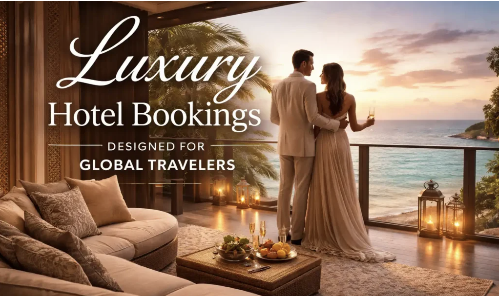
Luxury Hotel Bookings Designed for Global Travelers
Why Luxury Hotel Booking Has Become a Strategy, Not Just a Reservation
Luxury hotel bookings no longer starts with a pretty lobby photo or a thread count claim. Today, it behaves more like portfolio selection than impulse shopping. A global traveler who books a premium stay is often weighing suite category, private airport transfer, loyalty value, security standards, wellness offerings, dining access, flexible cancellation, and VIP service depth in one decision. That shift is not theoretical. Marriott reported that demand for luxury stays remained powerful enough for its global luxury room revenue to rise more than 6%, while U.S. luxury room revenue rose 4.9% even as lower-tier segments softened. Reuters also reported Marriott projected a 35% jump in co-branded credit-card fee revenue, driven by affluent travel demand, which shows how closely luxury hospitality, premium finance, loyalty ecosystems, and high-value booking behavior now move together.
When you look at the market through that lens, a luxury booking is not really a room purchase at all. It is a bundled decision about time efficiency, status recognition, privacy, financial optimization, and emotional return on travel spending. That is why the strongest-performing luxury hotels are not selling “beds.” They are selling certainty. They promise that a red-eye arrival will not turn into a front-desk delay, that a wellness request will not be treated like a special favor, and that a high-net-worth guest will not need to explain their preferences twice.
In premium travel, friction is the real enemy. A standard hotel can recover from minor inconvenience. A luxury hotel cannot afford it, because the guest is not paying only for comfort. The guest is paying to remove noise from the journey, the way noise-canceling headphones remove cabin roar from a long-haul flight. That is exactly why luxury hotel bookings designed for global travelers need to be engineered around experience architecture, not just availability.
The shift from room-only decisions to experience-led booking
A few years ago, many travelers still separated the hotel from the rest of the trip. Now, especially in the premium segment, travelers increasingly choose properties based on how well the stay plugs into the broader experience. Hilton’s 2025 trends research, based on 13,000 travelers across 13 countries. Found that travelers want to maximize both their time and financial investment, with strong interest in active travel, wellness, culinary experiences, digital convenience. And blended work-leisure behavior. Hilton CEO Chris Nassetta said travelers want to “maximize every moment of their time away,” and that line captures the modern luxury traveler surprisingly well.
That mindset changes the booking journey in practical ways. A luxury traveler is more likely to ask whether the hotel can coordinate a chauffeured arrival, priority dining reservation, spa sleep program, executive meeting space, yacht access, private guide, luxury travel insurance compatibility, and premium card benefits before even looking at the room photos. In other words, the room is the stage, but the performance includes everything around it. This matters for hotels targeting high-eCPM advertising categories too. Because the buying intent around luxury lifestyle, premium travel, private aviation, high-end finance, concierge medicine, wealth travel perks, and elite loyalty programs is commercially valuable. The most effective luxury booking content reflects that high-intent search behavior without sounding robotic. It speaks to what affluent travelers actually care about: less hassle, more control, stronger personalization, and access that feels difficult to replicate elsewhere.
Why affluent travelers are planning earlier and spending more deliberately
Affluent travelers are not necessarily spending carelessly. They are spending with sharper intent. Virtuoso’s 2026 Luxe Report found that advisors expected travel demand to rise and per-trip spending to stay high, with 55% predicting a modest increase and 28% expecting spending to remain steady. That is an important distinction. High-end travelers are still willing to spend, but they are weighing value through quality, relevance, and exclusivity, not through bargain logic.
The same pattern appears in loyalty behavior. American Express reported that 50% of global respondents planned to use credit card or travel points on trips in 2025, 45% chose destinations based on where points could be used best, and 43% planned to book a vacation after earning a specific amount of points. Two-thirds also said combining card rewards with loyalty perks provides the best value for international trips.
This is where luxury booking gets smarter. The modern premium traveler is not asking, “Can I afford this?” They are asking, “Is this the smartest place to deploy my money, points, benefits, and time. That is a wealth-management style question, which is exactly why the overlap between luxury hotel bookings, premium credit cards, international travel rewards, and financial lifestyle planning has become so strong. A suite booked through the right channel may include breakfast, a property credit, airport transfer, late checkout, room upgrade priority, and preferred amenities that materially change the trip. So yes, the sticker price matters, but the total value stack matters more. In premium hospitality, value is not a discount. Value is depth.
What Global Travelers Expect Before They Even Arrive
Before a luxury traveler sees the lobby chandelier or the skyline from the suite. The hotel has already started telling a story. The booking interface, response speed, payment confidence, messaging clarity. And pre-arrival personalization all signal whether the property truly understands premium travel. That early stage has become incredibly important because the traveler is often booking across borders, time zones, currencies, and expectations. A guest flying from London to Dubai, Singapore to Paris, or New York to Tokyo does not want vague promises. They want signal, structure, and reassurance. Marriott’s Asia Pacific luxury travel report found that wellness, meaningful experiences. And purposeful travel are shaping decisions among affluent travelers, while Amex data shows travelers are using points and benefits more strategically across the planning and booking process.
That means luxury hotel websites and booking teams need to operate like premium advisors, not passive order takers. The traveler should be able to understand suite differences clearly, compare inclusions, identify airport transfer options. See dining or spa access, and confirm flexible policies without hunting through clutter. Think of it like entering a private members’ lounge versus a crowded terminal gate. One environment lowers your blood pressure. The other raises it. The best luxury booking systems create that lounge feeling before the trip even begins. They make the guest feel expected, recognized, and protected. In high-end hospitality, anticipation is part of the product.
A seamless digital journey from search to suite selection
Digital convenience is no longer a “nice extra” in luxury hospitality. Hilton found that 63% of travelers value the option of a digital room key, allowing them to go straight to their room without stopping at the front desk. That statistic might sound simple, but it says something bigger: premium travelers increasingly expect technology to remove friction while keeping the experience elegant.
A seamless digital booking journey should allow guests to move from discovery to decision without uncertainty. That includes multi-currency pricing, secure payment, transparent cancellation terms, suite-specific visuals, direct messaging, mobile check-in, digital key access, and loyalty recognition. For global travelers, this is especially critical because travel fatigue starts long before landing. When the hotel’s digital touchpoints are clumsy, the brand feels less premium no matter how beautiful the property looks in photos. By contrast, a polished booking path creates trust. It tells the traveler that the property respects their time in the same way a private transfer respects their schedule. That is one reason why the strongest luxury hotel brands invest so heavily in guest technology, customer data intelligence, direct booking optimization, and loyalty-linked personalization. They are not trying to replace hospitality with software. They are using software to make hospitality feel effortless.
Personalized service before arrival, not after check-in
Real luxury starts before the guest touches the door handle. A premium property should know whether the guest prefers a quiet high-floor suite, a hypoallergenic setup, a plant-forward tasting menu, a late-night arrival snack, or a boardroom-ready workspace. Personalization at this level is not performative. It is operational. It saves time, protects mood, and makes the guest feel known. Marriott’s luxury trends reporting in Asia Pacific highlighted how wellness and intentional travel are influencing affluent decisions, which suggests that guests increasingly want stays that fit their personal rhythm rather than forcing them into generic hotel programming.
Picture a traveler arriving in Singapore after a 14-hour flight for a private equity meeting. The wrong hotel experience asks, “Would you like help with anything?” The right one has already arranged express arrival, in-room pressing, preferred tea, a car on standby, and a dinner reservation that fits the guest’s calendar. The difference is subtle on paper and enormous in real life. This is why premium travelers gravitate to brands and advisors that can capture preferences accurately and act on them. In luxury hospitality, service is not impressive because it is flashy. It is impressive because it feels almost telepathic. That “they already thought of it” feeling is the real gold standard.
Privacy, security, and trust as part of premium hospitality
For international luxury travelers, privacy is not an abstract concept. It is a booking filter. High-profile executives, family office principals, celebrities, founders, and ultra-affluent leisure guests often evaluate a hotel through the lens of discretion just as much as style. They want private entrances, controlled access floors, secure payment handling, professional staff conduct, and confidence that personal preferences will not become gossip. Although many hotel websites underplay this in their marketing, travelers absolutely notice it when deciding where to stay.
This is one reason experience-led luxury has such strong staying power. Premium travelers are not only paying for visible amenities like ocean-view villas, penthouse suites, curated wine programs, spa therapies, and private dining. They are also paying for invisible architecture: staff training, communication protocols, transport coordination, and guest privacy systems. In practical terms, trust can be the deciding factor between two equally beautiful properties. One hotel may have a prettier pool, but the other makes the guest feel protected. In luxury travel, protected often wins. It is like choosing a beautifully tailored coat that is also weatherproof. Style matters, but confidence in performance closes the sale.
Premium Facilities That Justify Premium Rates
A premium rate needs premium substance. That sounds obvious, yet many hotels still confuse expensive with luxurious. True luxury is not created by marble alone. It comes from facilities that materially improve the guest’s life during the stay. Marriott’s Asia Pacific luxury-travel findings show wellness has become central to booking decisions, with 90% of travelers citing wellness experiences as a key factor and Asia leading as a preferred destination for these journeys.
That tells us something important: the luxury traveler is no longer satisfied with generic indulgence. They want private spa access, longevity-oriented wellness, sleep optimization, fine dining, cultural immersion, private transfers, exclusive-use spaces, and tailored recreation that feel relevant to who they are. A premium facility should answer a real need or elevate a real desire. That might be a villa with direct beach access for a celebratory family trip, a soundproof executive suite for deal-making on the road, or a restorative sleep program for a burned-out founder who values recovery as much as status. Premium facilities justify premium rates when they turn the hotel from a backdrop into a performance enhancer.
Signature suites, branded residences, and private-use spaces
At the top end of the market, the suite is no longer just a bigger room. It is often a protected environment designed for privacy, hosting, and emotional impact. Signature suites, branded residences, and villa-style accommodations appeal to travelers who want space that feels more like temporary ownership than temporary lodging. This matters for international luxury guests because the stay may involve business meetings, family milestones, security concerns, or simply the desire to move through a destination without public friction.
A global traveler booking a three-bedroom branded residence in Dubai, a skyline suite in Tokyo, or an overwater villa in the Maldives is buying freedom as much as aesthetics. They want to take breakfast privately, host a meeting without relocating, recover from jet lag without interruption, and enjoy a setting that feels distinct from standardized premium inventory. That is why hotels that offer private terraces, plunge pools, club access, residence-style layouts, dedicated butlers, and secure elevator access can command stronger rates and stronger loyalty. In the luxury segment, the most valuable square meter is often the one that creates emotional ease.
Wellness, longevity, and restorative amenities
Wellness has become one of the clearest drivers of premium travel demand. Marriott’s luxury research found 90% of surveyed travelers saw wellness experiences as a key booking factor in 2025, up from 80% a year earlier, while Hilton reported that more than a quarter of travelers planned to book a spa or wellness treatment to enhance sleep.
That matters because wellness in luxury hospitality is no longer limited to massages and scented candles. High-end travelers increasingly want sleep-focused suites, nutrition-led dining, recovery therapy, fitness programming, meditation, circadian lighting, thermal circuits, and holistic diagnostics. They are treating travel not as a break from wellbeing, but as an opportunity to improve it. For advertisers and publishers, this is also one of the most commercially attractive intersections in content because it connects luxury wellness travel, premium healthcare, insurance, affluent lifestyle, longevity services, and elite hospitality in a way that aligns naturally with high-value reader intent. For the traveler, though, the logic is simpler. If a hotel can help them feel sharper, calmer, and better rested, that stay becomes memorable in a deeper way than décor ever could.
Dining, transfers, and integrated lifestyle access
Luxury travelers do not evaluate facilities in silos. They care about how everything connects. A Michelin-level dining partnership matters more when it is easy to book. A stunning spa matters more when it is paired with late checkout and a smooth airport transfer. A private beach matters more when the butler can arrange sunset dining without drama. This integration is where many luxury bookings either shine or fall flat.
American Express reported that many travelers are using points and stacked benefits strategically for international trips, and 45% choose destinations partly based on where they can best use those rewards.
That means integrated value is becoming more visible during booking. The traveler is asking whether the stay includes breakfast, spa credits, dining privileges, airport assistance, executive lounge access, or premium partner benefits that make the trip feel smoother and more rewarding. In practical terms, a property that coordinates culinary reservations, chauffeur logistics, shopping appointments, yacht charters, or premium event access is competing on a different level from one that merely offers a room with a view. In luxury hospitality, the richest amenity is often orchestration.
VIP Service That Turns a Good Stay Into an Irreplaceable One (Luxury Hotel Bookings)
If premium facilities create the frame, VIP service paints the masterpiece. Service is still the clearest differentiator in luxury hospitality because hard products can be copied faster than human execution. A rival can renovate a suite. It cannot easily replicate a team that reads context, acts discreetly, and solves problems before the guest sees them. That is why the most admired luxury hotels rarely describe service as “friendly” alone. Friendly is expected. Precision, anticipation, and discretion are what lift a stay into the premium tier.
This is also where the commercial power of the luxury segment becomes obvious. Reuters reported Marriott’s CEO described international demand for luxury as “almost insatiable,” and that is not just about affluent consumers spending more for the sake of it. It reflects the fact that once travelers experience truly high-level service, they become reluctant to step backward.
Butler service, concierge intelligence, and invisible efficiency (Luxury Hotel Bookings)
The best VIP service feels less like theater and more like perfect timing. Butler service is not about standing near the guest waiting to be noticed. It is about understanding when to appear, when to disappear, and how to make a complex stay feel simple. A capable luxury concierge does something similar. They do not merely hand over restaurant names. They shape access, sequence, and experience.
Imagine an international traveler in Paris combining board meetings, client dinners, and a two-day leisure extension. A standard hotel can provide a room. A true luxury hotel can build rhythm: airport arrival support, garment pressing, car arrangements, reservation management, private museum access, secure shopping recommendations, and spa timing calibrated around the guest’s schedule. That is not just service. That is travel design. It is also one of the strongest reasons travelers return to the same brands, advisors, and booking channels. They remember how the trip felt when everything clicked.
Loyalty status, premium cards, and elite travel privileges (Luxury Hotel Bookings)
Luxury hotel bookings now sit inside a wider premium ecosystem that includes elite loyalty status, co-branded credit cards, airport privileges, global points strategy, and travel-advisor access. American Express data shows travelers are actively using points and benefits to shape where and how they travel, while Reuters reported Marriott expects substantial growth in co-branded card fees because luxury demand remains robust.
For global travelers, this changes the booking conversation dramatically. The smartest booking is not always the publicly visible rate. It may be the one that unlocks room upgrades, breakfast, property credits, flexible checkout, loyalty earnings, and VIP treatment. That is why premium travelers increasingly think in terms of ecosystem value rather than isolated pricing. A beautifully priced suite that delivers no recognition may lose to a slightly higher rate that includes elite treatment and meaningful privileges. It is the luxury version of choosing a business-class ticket with lounge access, priority services, and better timing instead of chasing the absolute cheapest fare. The total journey matters more than the initial number on the screen.
Real-World Booking Scenarios for International Luxury Travelers (Luxury Hotel Bookings)
Luxury booking advice becomes far more useful when it leaves theory and enters the real world. Let’s ground it in actual contexts. Global travelers do not all book for the same reason, even when they spend at a similar level. Some want executive efficiency. Others want emotional theater. Some need privacy above all else. Others want celebratory excess done tastefully. The strength of a luxury hotel booking strategy lies in matching the property and booking channel to the purpose of the trip.
That is where many travelers go wrong. They book a beautiful hotel that is wrong for the moment. A resort-style property may disappoint on a fast-moving business schedule. A city hotel may feel emotionally flat for an anniversary trip. The smartest luxury booking is always contextual. It answers not only “Where should I stay?” but “What kind of trip am I trying to create?”
A Tokyo executive stay designed around time, privacy, and precision (Luxury Hotel Bookings)
Consider a founder or investor flying into Tokyo for four nights of meetings. The ideal booking is not just a luxury room in a famous district. It is a property that minimizes transit friction, handles early arrival gracefully, offers soundproofed executive comfort, provides rapid garment care, supports bilingual concierge service, and can secure intimate client dining. In this scenario, the guest should prioritize suite efficiency, location strategy, airport transfer reliability, meeting-friendly common spaces, privacy, and loyalty-linked benefits over resort-style indulgence.
This is where premium hospitality earns its reputation. A well-chosen Tokyo luxury hotel can function almost like a temporary headquarters. The guest lands tired, but the room is ready, the car is arranged, the internet is flawless, the dining is curated, and the staff understand that every minute matters. Nothing feels loud. Nothing feels improvised. The stay becomes a precision instrument. That is what international luxury travelers often want when they travel for business with lifestyle expectations intact.
A Maldives celebration built around exclusivity and emotional value (Luxury Hotel Bookings)
Now flip the context. Imagine a couple booking the Maldives for a milestone anniversary. Suddenly, the priorities change. The best-fit property may be one with villa privacy, a private pool, marine experiences, in-villa dining, sunset rituals, spa programming, photographer access, and personalized arrival touches. In this case, emotional pacing matters more than business efficiency. The guest is paying for atmosphere, memory, and symbolic value.
This is exactly why luxury hotel booking content should not sound generic. The right booking is always tied to traveler intent. A celebratory couple may care deeply about seaplane coordination, villa orientation, private dining design, or whether the property can arrange a custom renewal moment on the beach. The room category matters, but the emotional script matters more. A truly premium hotel understands that the guest is not booking inventory. They are booking a future memory. And when the hotel delivers that memory cleanly, the stay feels priceless even when it is very expensive.
Conclusion (Luxury Hotel Bookings)
Luxury hotel bookings designed for global travelers work best when they are built around the traveler’s real purpose, not around generic prestige. The new premium traveler values privacy, time efficiency, wellness, ecosystem benefits, exclusive experiences, and service intelligence as much as visual beauty. Current market signals support that direction: luxury demand remains resilient, travelers are spending strategically, and premium ecosystems tied to loyalty and finance continue to influence where bookings go.
The winning formula is surprisingly human. People with means still want to feel understood. They want someone to reduce friction, protect their time, and shape the stay around what matters most to them. That could mean an executive suite in Tokyo, a wellness-led escape in Asia, or a celebratory villa in the Maldives. The property changes. The principle does not. Great luxury booking is not about excess for its own sake. It is about designing a journey so well that the traveler never has to wrestle with the trip. They simply step into it.