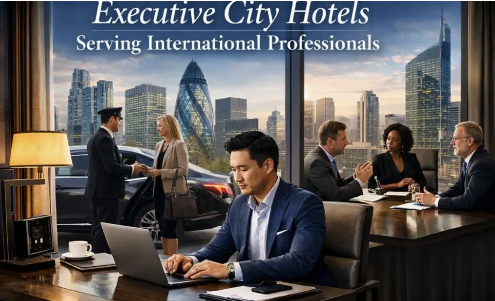
Why Executive City Hotels Matter More Than Ever
The return of high-value global business mobility
Executive city hotels is no longer just a place to sleep between meetings. For international professionals, it has become part office, part sanctuary, part private club, and part status signal. That shift matters because global travel demand has come roaring back in ways that favor premium hospitality. UN Tourism reported that international tourist arrivals grew 4% in 2025 to an estimated 1.52 billion, which signals a travel market that is not merely recovering but expanding into a more competitive, quality-driven era. On the corporate side, the Global Business Travel Association projected global business travel spending would reach $1.57 trillion in 2025, a record high, showing that face-to-face meetings, investor roadshows, cross-border dealmaking, and executive travel still carry enormous strategic value.
That combination of rising global mobility and record business travel spend creates a clear reality for the hotel sector: the winning properties are not average properties. They are executive city hotels that understand how premium travelers think. An international lawyer flying into Singapore, a private equity partner arriving in London, a regional technology director landing in Dubai, or a wealth management consultant checking into Tokyo all share one priority: they need the city to work for them immediately. They do not want friction, uncertainty, or wasted time. They want efficient airport access, a refined room, enterprise-grade connectivity, secure meeting space, personalized dining, and service that feels intuitive rather than scripted. In that world, the hotel becomes less like a passive building and more like a precision instrument—something calibrated to protect time, support performance, and reinforce a luxury lifestyle that many high-value travelers now expect as standard.
Why premium city hotels outperform generic business stays
A generic business hotel can provide a bed, a desk, and breakfast. A true executive hotel provides decision-making comfort. That difference sounds subtle until you think about the traveler’s real schedule. International professionals often arrive after long-haul flights, face immediate meetings, manage multiple time zones, and carry reputational pressure into every room they enter. In that context, premium hospitality is not indulgence for its own sake. It is operational support wrapped in elegance. A lounge with private check-in saves time. A concierge who can arrange a late-night car service to a financial district dinner protects continuity. A soundproof suite with blackout controls and excellent bedding improves sleep and executive function the next morning. Suddenly, “luxury” is not decorative—it is productive.
This is exactly why premium and luxury urban hotels continue to command attention in travel strategy. Skift Research noted that luxury hotels have remained comparatively resilient and have experienced less RevPAR volatility than other segments, reflecting how upper-tier demand behaves differently from mass-market demand. Hilton’s travel trends reporting also shows luxury travelers place a premium on restorative experiences, with 70% of luxury travelers choosing hotels with sleep-centric amenities. That number reveals something larger than wellness marketing. It tells us that elite travelers are increasingly judging hotel quality not only by marble lobbies and brand prestige, but by performance outcomes: better sleep, smoother routines, lower stress, sharper focus, and more control over the urban experience.
Who International Professionals Really Are
Corporate executives, investors, consultants, diplomats, and founders
When people hear the phrase international professionals, they often imagine a narrow corporate archetype: someone in a navy suit with a roller bag and a laptop. The real audience is much broader and much more valuable than that stereotype suggests. This category includes C-suite executives managing regional portfolios, investment bankers handling mergers, venture capital partners meeting founders, management consultants rotating across capitals, diplomatic staff, aviation and shipping leaders, global healthcare specialists, luxury retail directors, legal advisers, and high-growth entrepreneurs whose calendars stretch across continents. These travelers do not simply consume hospitality. They influence high-margin sectors like premium aviation, private wealth, financial services, global insurance, legal advisory, and enterprise technology—all categories closely aligned with strong advertiser value and premium audience monetization.
That makes the editorial framing of executive hotels especially powerful in SEO terms. A reader searching for an executive city hotel is often not searching casually. They may be looking for the right property before a summit, a negotiation, a board meeting, or a client-facing trip. This is a commercially rich audience. They are more likely to book suites, private transfers, club-level rooms, flexible meeting spaces, and premium dining. They are also more likely to respond to content tied to luxury travel, elite business accommodation, executive suites, private airport transfer, premium concierge service, wealth-focused travel, and five-star business hospitality. Those are not low-intent keywords. They signal decision-making power, and that is exactly why hotels targeting international professionals should speak in a tone that is polished, credible, and commercially aware.
What this audience expects from luxury urban accommodation
International professionals do not separate “business” and “lifestyle” as sharply as many hotel marketers still do. The old model assumed the traveler worked all day and slept at night, needing little more than Wi-Fi and a breakfast buffet. Today’s high-value guest expects a more integrated experience. They may take a morning investor call, host an executive lunch, fit in a recovery treatment at the spa, then entertain clients over a chef-led tasting menu. They want a room that supports work, but they also want a property that reflects taste, confidence, and discretion. Luxury, for this audience, is not loud. It is composed. It feels smooth, private, responsive, and quietly exact.
This shift is echoed in current travel trend data. Hilton’s reporting highlights a market where work, rest, wellness, and experience increasingly overlap, while Accor’s 2025 outlook points to continued traveler interest in lifestyle-led and experience-driven hospitality. In practice, that means an executive guest may care as much about in-room lighting, mattress quality, and the privacy of the lounge as about the speed of check-in. They may ask whether the hotel can coordinate secure transfers, accommodate dietary requirements, prepare garments for a gala dinner, or facilitate a boardroom setup within hours. The best executive city hotels understand that every touchpoint carries meaning. One weak link—a slow car request, noisy room placement, poor sound insulation, awkward front-desk handling—can undermine the entire luxury promise.
The Core DNA of an Executive City Hotel
Prime financial-district location and fast connectivity
Location has always mattered in hospitality, but for executive travelers it behaves almost like a hidden currency. A hotel near a financial district, embassy cluster, convention venue, luxury retail corridor, or headquarters ecosystem holds practical and symbolic value at once. It reduces transit stress, shortens schedule gaps, simplifies client meetings, and gives guests proximity to the city’s most influential addresses. The strongest executive hotels are strategically positioned near airports with premium transfer routes, rail hubs with express connections, or core commercial zones where one can move from suite to boardroom in minutes rather than hours.
That sounds obvious, yet many properties still overestimate what location means. It is not enough to be “in the city.” An executive property must be in the right part of the city. Marriott’s positioning for several urban luxury and upper-upscale properties shows how strongly hotels now market access to financial districts, high-profile meetings, and walkable prestige zones. That positioning works because international professionals are not buying only accommodation; they are buying urban efficiency with status alignment. Think of the hotel as a launchpad. If the launchpad is weak, the whole trip feels compromised. If it is excellent, even a packed itinerary feels manageable.
Seamless arrival, security, and privacy
An executive guest notices the first ten minutes more than the next ten hours. Arrival creates trust or doubt almost instantly. Was the airport transfer smooth? Did the staff recognize the guest profile? Was there a wait at reception? Was the room ready, quiet, and aligned with preferences? Were security procedures visible without feeling intrusive? The best executive city hotels treat arrival like a private handshake—confident, efficient, and calm. They understand that many international professionals carry sensitive conversations, confidential documents, or simply a desire for discretion. A visible-yet-subtle security culture matters enormously in top-tier urban hospitality.
Privacy is often underestimated in hotel content, but it is central to premium positioning. A founder negotiating funding, a diplomat meeting contacts, or a multinational executive visiting a new market may value discretion more than visual spectacle. That is why features like private entrances, executive floors, lounge check-in, controlled elevator access, chauffeur coordination, in-room dining handled elegantly, and staff trained in guest confidentiality all matter. Luxury is sometimes compared to theater, but in executive hospitality it behaves more like choreography. Guests should feel supported without feeling watched. When a hotel gets this right, it communicates something rare: you can do serious work here, and you can do it comfortably.
Rooms designed as private productivity suites
An executive room should never feel like a generic guest room with a desk pushed against the wall. It should feel like a compact, polished control center. That means excellent sound insulation, dependable high-speed internet, generous desk space, intuitive lighting, multiple charging points, ergonomic seating, quality coffee and tea service, intelligent storage, and a bathroom that restores rather than merely functions. The room has to support rapid shifts in mode: recovery, remote work, grooming, virtual meetings, document review, private dining, and genuine sleep.
This matters because the line between accommodation and workspace has blurred. Hilton’s travel trend materials and broader premium-hospitality strategy both point toward travelers seeking more personalized and functional in-stay environments, especially where wellness and productivity intersect. That can include sleep-focused rooms, in-room fitness options, app-based control, or curated amenities that help travelers regulate long-haul fatigue. For international professionals, the room is not the pause button of the trip. It is the central operating base. A strong executive suite allows a guest to land late, reset fast, work privately, and step back into the city looking composed. That is not just hospitality design. It is performance architecture.
Premium Facilities That Shape Hotel Choice
Club lounges, boardrooms, wellness floors, and concierge desks
Executive travelers rarely judge a hotel by one feature alone. They judge by the ecosystem of features that make a demanding schedule feel lighter. This is where premium facilities become decisive. A well-designed executive lounge can function as breakfast room, quiet office, informal networking venue, and late-evening decompression zone in one. A properly equipped boardroom lets a guest host confidential meetings without leaving the property. A concierge desk with real local influence can secure a restaurant that is fully booked, arrange private transport during peak hours, or solve last-minute itinerary problems without drama. Even the fitness center matters more than many marketers assume, because frequent international travelers often anchor their routines around controlled wellness rituals that help them stay sharp.
The same logic applies to spa and wellness facilities. For an international professional, a treatment room, thermal suite, or recovery-focused wellness floor may have less to do with indulgence than with restoring mental clarity after flights, time-zone disruption, and negotiation-heavy days. Hilton’s 2025 trends findings, especially the emphasis on sleep-centric amenities and wellness-oriented travel behavior, reinforce why recovery has become a genuine luxury driver. A premium city hotel that combines business infrastructure with sophisticated wellness is no longer “adding lifestyle.” It is aligning with how elite travelers now manage performance and fatigue.
Fine dining, airport transfers, and chauffeur-driven convenience
Executive hospitality becomes memorable when it protects the guest from decision fatigue. Fine dining inside or adjacent to the hotel matters not only because it is elegant, but because it removes uncertainty from important moments. A senior executive hosting a client does not want to gamble on a distant restaurant with unpredictable service. They want a setting that is polished, discreet, and reliable. The same goes for airport logistics. Chauffeur-driven transfers, fast luggage handling, and coordinated departures are not “extra touches” in this segment. They are part of the service architecture that justifies premium rates.
Here is a simple comparison that shows how executive hotels distinguish themselves from standard urban properties:
| Feature | Standard City Hotel | Executive City Hotel |
|---|---|---|
| Check-in experience | Front desk queue | Private or priority arrival |
| Room setup | Basic desk and bed | Productivity-focused suite |
| Dining | General all-day dining | Fine dining and private hosting options |
| Transport | Taxi recommendations | Chauffeur, airport transfer, route coordination |
| Meetings | Limited shared room | Boardroom-grade private spaces |
| Wellness | Small gym | Recovery-led wellness and spa offerings |
| Guest support | Reactive | Personalized, discreet, anticipatory |
That table may look straightforward, but it captures a deeper commercial truth: executive hotels win when they remove friction before the guest has to mention it. This is where premium revenue grows. Guests who trust the property are more likely to upgrade rooms, use private dining, book transfers, extend stays, and attach leisure experiences to business trips. For hotels, that means stronger ancillary revenue. For travelers, it means a smoother, more elevated journey.
The role of sleep, wellness, and recovery in executive travel
Sleep has quietly become one of the most powerful signals of luxury quality. Not flashy luxury. Functional luxury. Hilton’s data showing that 70% of luxury travelers choose hotels with sleep-centric amenities is revealing because it points to a new hierarchy of value. The guest may appreciate an impressive lobby, but they will remember blackout curtains that actually work, a mattress that supports deep rest, silent air-conditioning, quality linens, and a room layout that doesn’t feel visually noisy after midnight. Recovery has become part of the premium promise because modern travelers understand that exhaustion is expensive.
Think about a professional arriving from New York to Dubai, or from Jakarta to London, with meetings beginning the next morning. The real value of the hotel is not just the address or the thread count. It is the property’s ability to help that traveler recover physically and mentally in a compressed time window. That is why sleep menus, in-room wellness content, high-quality bath amenities, curated tea selections, spa access, and even acoustic design now matter so much in upper-tier city hospitality. The best executive hotels do not simply sell a room for the night. They sell the ability to show up tomorrow at full strength.
VIP Service as a Revenue-Driving Differentiator
Personalized service, loyalty recognition, and discreet support
There is a point in luxury hospitality where hardware stops being the main differentiator. Then a hotel has excellent rooms, a strong location, beautiful interiors, and the expected amenities, service becomes the factor guests remember and pay for. VIP service in an executive setting is not about exaggerated formality. It is about relevance. Did the staff remember the guest’s preferred room orientation? Did they note dietary needs without making the guest repeat them? Was a pressing request handled in time for a dinner? Did the concierge understand the tone of the guest’s itinerary? Small details, when delivered intelligently, create the feeling that the hotel is operating at the guest’s level.
This is also where loyalty and personalization become commercially powerful. Business travel remains a massive global sector, and returning travelers can drive repeat revenue across rooms, dining, meetings, and upgrades. GBTA’s record-spending forecast reinforces why hotel brands continue investing in better traveler recognition and experience design. Then properties that serve international professionals well are not just filling rooms. They are building trust with travelers who may return multiple times each year and influence broader corporate booking patterns. A loyal executive guest can become a recurring revenue stream, a brand advocate, and a signal to other premium travelers that the property is worth paying for.
Why elite guest experience increases brand trust
Brand trust in luxury hospitality is often built through consistency under pressure. Anyone can look polished on a quiet afternoon. The real test comes when flights are delayed, itineraries change, rooms need to be shifted, privacy issues arise, or a guest requires last-minute support across multiple departments. This is where elite service turns from pleasant to strategic. A hotel that handles complexity calmly becomes more than a preferred stay; it becomes part of the traveler’s risk management.
That matters especially for international professionals who live in environments where time, reputation, and discretion carry financial consequences. A poor stay is not just inconvenient. It can disrupt a client dinner, affect sleep before a presentation, or create unnecessary mental drag during a high-stakes week. The best executive city hotels understand this and train service teams accordingly. They aim to create a guest experience that feels unforced, polished, and almost editorial in its clarity: every detail in the right place, every interaction measured, every problem solved before it becomes visible. That is how hotels protect premium pricing without sounding defensive about it. They let the guest feel the value.
Exclusive Experiences Beyond the Guest Room
Curated city access, private shopping, and invitation-only events
Executive city hotels do not trap the guest inside the building. They act as gatekeepers to the city’s best private experiences. Then that can mean after-hours museum access, discreet personal shopping, reservations at chef-led restaurants, invitation-only cultural events, private yacht or harbor experiences, premium golf arrangements, or chauffeured routes designed around a guest’s business and leisure schedule. Luxury today is increasingly defined by access, and Skift’s reporting on 2025 luxury travel makes clear that exclusivity is being reframed around high-quality experiences, personalization, and meaningful value rather than pure display.
For international professionals, these curated layers matter because business trips are no longer purely transactional. Many are extended, blended, or strategically social. A guest may finish meetings by afternoon and want a cultural experience suitable for a partner, client, or private network. Then they may want the city interpreted, not merely presented. The hotel that can bridge the professional and personal sides of travel gains a real edge. It becomes useful beyond the room key. That utility is what transforms a single booking into long-term preference.
Examples of executive hospitality in real business destinations (Executive City Hotels)
Consider a financial executive staying in Singapore for a regional banking summit. The ideal hotel is not simply near Marina Bay or the CBD. It also offers a quiet club floor, secure transport, fast meeting support, polished dining suitable for client entertainment, and a spa that helps reset after red-eye arrival. In London, an international law partner may prioritize Mayfair or the City, but also needs discreet service, excellent breakfast timing, and a room that supports late-night document review without fatigue. That in Dubai, a private wealth adviser may value DIFC proximity, premium transfer options, wellness recovery, and strong restaurant partnerships for business dinners. In Tokyo, an executive traveler may care deeply about service precision, privacy, transit efficiency, and a hospitality culture that feels exact without being overbearing.
These are not fantasies. They reflect the actual operating logic of premium urban hotels in global business capitals. Marriott, Hilton, and Accor all continue to position premium and luxury city properties around mixed-use urban demand that blends meetings, events, high-end dining, wellness, and culturally embedded experiences. The message is clear: executive city hotels are no longer selling only rooms to business travelers. They are selling premium urban command centers for people whose schedules and expectations are both international.
Choosing the Right Hotel for International Professionals (Executive City Hotels)
What companies, travel managers, and guests should evaluate (Executive City Hotels)
Selecting the right executive city hotel should feel less like chasing stars on a rating chart and more like evaluating a strategic partner. Companies and travel managers should look at location relevance, privacy standards, airport accessibility, room functionality, lounge quality, meeting infrastructure, dining reliability, wellness depth, guest-service responsiveness, and brand consistency across cities. The best properties make an executive traveler’s routine easier from the moment the booking is confirmed. That includes pre-arrival communication, flexible check-in support, documented preferences, and clear solutions for transfers, meeting rooms, and dietary requests.
Guests themselves should think similarly. Does the property support the actual shape of the trip? Will it help with jet lag recovery? Can it host a private conversation over dinner without noise and chaos? Does the room allow real work, not just symbolic work? Are the staff practiced with high-pressure travelers, or are they simply performing scripted luxury language? A strong executive hotel does not need to shout. Its competence shows up in clean details, strong systems, and the quiet confidence that nothing important will be mishandled.
Red flags that weaken a premium hotel proposition (Executive City Hotels)
The red flags are usually easy to spot once you know what matters. A glamorous property with weak soundproofing is a problem. A well-located hotel with poor transfer coordination is a problem. A beautiful suite with too few charging points, awkward work surfaces, or unreliable Wi-Fi is a problem. A hotel may market itself as luxury while failing to offer meaningful privacy, security awareness, or service flexibility. In executive travel, surface-level elegance cannot compensate for operational weakness.
That is why hotel content targeting international professionals should stay grounded. Real luxury is not just chandeliers, skyline views, and polished marble. It is timing, consistency, and relevance. It is the feeling that a demanding trip will unfold smoothly because the property understands how serious travelers actually move through the city. For advertisers, travel brands, and publishers, this is where high-value content performs well. It speaks directly to affluent decision-makers without drifting into generic tourism language. It aligns with premium categories like business class travel, executive suites, international finance travel, luxury concierge service, premium travel insurance, wealth-management lifestyle, and global mobility solutions—all of which attract stronger commercial attention than budget-led travel intent.
The Future of Executive City Hotels
AI-enabled personalization, sustainability, and premium hybrid travel (Executive City Hotels)
The next generation of executive city hotels will likely be defined by three forces working together: personalization, sustainability, and hybrid premium travel. Personalization is moving beyond simple loyalty perks into predictive service—room preferences remembered across cities, smarter arrival planning, better in-room controls, tailored wellness suggestions, and concierge recommendations that match travel purpose. Sustainability is becoming part of corporate travel decision-making as organizations pay closer attention to procurement standards, operational transparency, and responsible hospitality choices. GBTA’s sustainability work for hotels and broader industry discussions around managed travel underscore that business travel buyers increasingly care about measurable standards, not just branding language.
Hybrid premium travel is the other defining force. The boundary between executive travel and luxury lifestyle travel will continue to blur. A traveler may arrive for meetings, extend for private leisure, bring a partner, host clients socially, or combine city business with a wellness stay. Hilton’s framing of overlapping work-and-play travel behavior points directly to this evolution. The hotels that lead the next era will be the ones that can support both intensity and restoration. They will feel efficient without feeling cold, luxurious without feeling theatrical, and international without becoming generic. In other words, they will serve not only the trip on paper, but the real human behind the itinerary.
Conclusion (Executive City Hotels)
Executive city hotels serving international professionals occupy one of the most valuable spaces in modern hospitality because they sit at the intersection of luxury lifestyle, premium travel, global business mobility, and high-touch service. They matter because international travel remains strong, business travel spending has returned to record levels, and affluent travelers now expect more than a comfortable room. That want privacy, speed, wellness, status, and urban access woven into one seamless experience. They want the hotel to function like a trusted extension of their professional life while still delivering the emotional ease and refinement associated with five-star hospitality.
The best executive hotels understand that luxury is most persuasive when it solves real problems beautifully. That means excellent location, frictionless arrival, productive suites, VIP service, recovery-driven wellness, curated experiences, and the kind of discreet competence that serious travelers recognize instantly. For hotel brands, publishers, and marketers aiming at premium audiences, this segment is exceptionally powerful because it attracts travelers linked to high-value sectors such as finance, legal services, technology, luxury retail, aviation, and wealth management. When content is written naturally, with real-world context and a clear understanding of what elite urban travelers need, it does more than rank—it converts attention into trust.