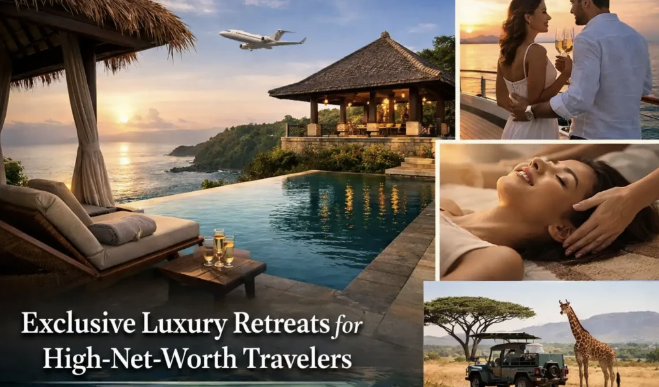
Exclusive Luxury Retreats for High-Net-Worth Travelers
The New Shape of Elite Travel
Luxury travel has changed. It is no longer enough for a property to offer a large suite, a polished lobby, and a beautiful infinity pool. For today’s affluent global traveler, true value comes from privacy, precision, and emotional reward. The most desirable exclusive luxury retreats for high-net-worth travelers are built around time protection, discreet service, curated wellness, and rare access that cannot be booked in a standard online package.
Recent luxury-travel research points in the same direction: Virtuoso’s 2026 Luxe Report says spend per trip is expected to remain high, with 55 percent of advisors forecasting a modest increase and 28 percent expecting spend to hold steady. While the Global Wellness Institute continues to show strong expansion in the wellness economy. That combination matters because it tells us something simple but powerful: affluent travelers are still spending. But they are spending more intentionally on premium travel, luxury lifestyle, wellness tourism, private villa escapes, and high-value hospitality experiences that feel deeply personal rather than publicly flashy.
In publishing and premium advertising, this is exactly where high-value commercial intent appears. Phrases such as private jet charter, luxury travel advisor, premium travel insurance, wealth management lifestyle, exclusive wellness retreat, and VIP airport services. Tend to attract stronger advertiser interest because the audience behind them is already moving close to purchase. That is why this topic sits at the crossroads of premium travel and high-eCPM finance and lifestyle keywords so naturally.
What Makes a Retreat Truly Exclusive
A truly exclusive retreat is defined by what it removes as much as by what it offers. It removes waiting, noise, overexposure, repetition, and friction. In its place, it offers calm, control, and customization. A beautiful resort can still feel ordinary if the guest has to stand in a line, repeat preferences, share the best spaces with crowds, or adapt to a rigid service schedule. By contrast, an elite retreat anticipates rather than reacts. It already knows whether the traveler wants complete privacy, social flexibility, family-friendly structuring, yacht access, private security coordination, or a deep wellness reset. That is the difference between expensive and exceptional.
The strongest luxury properties understand this almost instinctively. They create environments where architecture, service, and location all support the same feeling: protected freedom. A cliffside villa with a private pool and dedicated host offers more than visual beauty. It gives the traveler control over rhythm. Breakfast can happen late, a massage can be arranged in-suite, business calls can be taken without interruption. And dinner can be served under the stars without the guest feeling on display. For international luxury travelers who already live fast, visible, and highly scheduled lives, this kind of seclusion is not a bonus. It is the product itself. The room is simply the vessel.
Privacy Is the New Luxury Currency (Exclusive Luxury)
For high-net-worth individuals, privacy has become one of the most important travel assets. Many affluent travelers are not merely seeking comfort; they are seeking distance from public visibility, operational stress, and constant interruption. That is why low-density resorts, residence-style hospitality. And estate-like villa compounds continue to perform so well in the upper end of the market. Aman’s official positioning for Amanvari in Mexico describes the property as a peaceful escape and a private oasis at the edge of the Sea of Cortés. While Aman’s wider brand portfolio continues to emphasize luxury resorts and private residences designed around space and seclusion. That language works because it reflects what wealthy guests actually want: a place that lets them disappear without sacrificing standards.
This desire for privacy also influences design. The most compelling retreat layouts are often those that make the guest feel sheltered without making them feel confined. Think of stand-alone pavilions, oversized terraces, landscaped pathways, indoor-outdoor living rooms, private spa suites, hidden arrival routes, and staff choreography so refined that service feels present but never intrusive. In practical terms, this means a retreat can support multiple lifestyles at once. A founder can decompress after a demanding quarter. A multigenerational family can travel together without being forced into a single daily rhythm. A high-profile couple can enjoy romance without exposure. A private retreat, when properly built, becomes a kind of luxury firewall between the traveler and the noise of the outside world.
Why Wellness Now Sits at the Center of Premium Travel (Exclusive Luxury)
Wellness is no longer a decorative add-on in the luxury segment. It has become one of the main reasons affluent travelers choose one retreat over another. The Global Wellness Institute’s recent reports show that the wellness economy has continued to grow to record level. And that larger trend is reflected in how premium hospitality brands now position themselves. Guests are not just asking whether a resort has a spa. They are asking whether the stay will improve sleep quality, lower stress, support longevity, sharpen focus, and create lasting physical and mental benefits after the trip ends.
That shift has transformed the language of luxury. Older luxury promised indulgence. Modern luxury increasingly promises restoration. Six Senses is a clear real-world example of this movement. Its official wellness pages highlight expert-led retreats, mindful movement, self-discovery, sleep-focused programming, brain health, and longer-term wellbeing rather than one-off pampering. The brand’s broader wellness positioning also integrates sleep, nutrition, spa programs, and whole-stay wellbeing into the guest experience. That matters because it turns a trip into a structured reset rather than a glamorous pause button. For affluent travelers, especially those balancing business leadership, family responsibilities, international mobility, and demanding schedules, that kind of retreat feels relevant in a very practical way. It becomes easier to justify premium rates when the stay delivers beauty and measurable personal benefit at the same time.
Premium Facilities That Signal Real Value (Exclusive Luxury)
In this category, premium facilities are not about excess for its own sake. They are about usefulness wrapped in elegance. A private pool matters because it protects privacy. A villa butler matters because it reduces friction. A dedicated wellness suite matters because it keeps recovery within reach. A helicopter landing option, private marina connection, in-residence dining program, sommelier-led cellar access, or medically informed longevity menu matters because each one makes the stay more efficient and more personalized. For the affluent traveler, luxury is often best understood as the intelligent removal of inconvenience.
The most effective retreats therefore build their value through layers. The physical layer includes oversized villas, designer interiors, panoramic views, premium bedding, wellness bathrooms, and discreet security-conscious layouts. The service layer includes a dedicated host, private transfers, round-the-clock dining flexibility, VIP check-in, concierge-level itinerary management, and seamless coordination with a luxury travel advisor or personal assistant. The experiential layer includes rare dining access, private yacht charters, helicopter sightseeing, curated cultural encounters, destination-specific wellness rituals, and tailored family or couple programming. When all three layers work together, a retreat no longer feels like a luxury purchase. It feels like a luxury standard.
VIP Services That Affluent Travelers Quietly Expect (Exclusive Luxury)
True VIP service is rarely loud. It is subtle, efficient, and deeply informed. A guest in this segment often expects the retreat to understand their lifestyle before they arrive. That can mean arranging fast-track airport handling, coordinating with a private jet terminal, preparing allergy-sensitive menus, organizing secure off-property movement, or aligning spa treatments with jet lag recovery. These details are easy to underestimate, but they are precisely what separates a merely expensive stay from one that feels world-class.
What makes VIP service especially valuable is that it creates emotional softness around hard logistics. Many wealthy travelers move through complicated schedules, multiple geographies, and tightly managed calendars. They do not want the retreat to add one more thing to manage. They want the retreat to absorb complexity and return simplicity. That is why private aviation access, premium concierge services, executive security support, exclusive airport lounge experiences, and high-end travel insurance planning naturally fit within this editorial space. These are not random luxury extras. They are part of the infrastructure that allows high-net-worth travel to feel effortless.
Exclusive Experiences That Create Real Memory
A luxury retreat becomes unforgettable when it offers more than comfort. It needs to offer access. The most memorable examples are rarely generic sightseeing moments. They are private, rare, and emotionally textured experiences that feel almost impossible to duplicate. That could be a closed-door art viewing, a private vineyard dinner with the winemaker, an ocean expedition with a marine expert, a sunrise cultural ritual arranged with discretion and respect, or a desert astronomy session followed by a chef-led tasting beneath the stars.
This is where luxury travel becomes storytelling rather than spending. The affluent traveler does not want a checklist. They want a narrative. They want to return home with the feeling that they entered a place more deeply than the average visitor ever could. That is why curated rarity matters so much. It transforms the retreat from accommodation into access point. A great suite can impress someone for a night. A rare experience can define how they remember the entire year. In commercial terms, this is also where high-value editorial themes such as private yacht charter, luxury safari, Michelin-star travel, private island dining, fine wine tourism, and bespoke cultural journeys become especially effective for premium audiences.
Real-World Examples That Match the Luxury Trend (Exclusive Luxury)
A useful way to understand this market is to look at the types of retreats already shaping it. Amanvari represents the ultra-private sanctuary model, where landscape, seclusion, branded residences, and a carefully controlled sense of place speak directly to affluent travelers seeking quiet exclusivity. Six Senses represents the wellness-led luxury model, where biohacking-adjacent programming, sleep optimization, nutrition, movement, and emotional wellbeing are woven into the stay itself. Four Seasons represents another important angle through its private-journey and end-to-end luxury service ecosystem, including its private jet experience, which shows how some affluent travelers now want luxury to extend across the entire journey, not only at the destination.
These examples matter not because every traveler should choose those specific brands, but because they reveal what the market rewards. It rewards intimacy over scale, coherence over spectacle, and emotional relevance over generic prestige. A traveler choosing a desert retreat with residence-style privacy is expressing a different priority from a traveler choosing a wellness estate in Bali or a private-island villa in the Maldives, yet all three choices are driven by the same deeper goal: to protect time and heighten life. That is the real engine behind modern luxury travel.
Choosing the Right Retreat With Precision (Exclusive Luxury)
The smartest way to choose a retreat is to match the property to the traveler’s real goal rather than to a logo alone. A couple celebrating a milestone may need romance, privacy, and destination dining. A family office principal traveling with children may need layered privacy, multiple bedrooms, secure transport, and flexible service timing. A wellness-focused executive may need diagnostics, movement programming, recovery therapies, and low social exposure. A retreat can look perfect in photos and still feel wrong if its energy does not align with the guest’s needs.
That is why precision matters more than prestige. An affluent traveler should look closely at density, service style, privacy design, transfer logistics, dining flexibility, wellness quality, family suitability, and the retreat’s ability to personalize with minimal explanation. The best property is not automatically the most famous or the most expensive. It is the one that feels most intelligently aligned with the life of the person booking it. In that sense, choosing a retreat is a little like choosing a tailored suit or a long-term investment. Fit matters more than surface shine.
Why This Topic Performs Well for Premium Publishing (Exclusive Luxury)
There is also a business reason this subject works so well in content strategy. The luxury retreat niche sits inside several premium advertiser categories at once: travel, finance, insurance, aviation, luxury goods, real estate, and wealth services. That makes it especially attractive for Google AdX and Google Ad Manager environments that benefit from stronger commercial signals. Readers drawn to exclusive luxury retreats for high-net-worth travelers are often also interested in private banking, premium credit cards, wealth management, international real estate, private aviation, luxury cruise suites, and high-end travel insurance. Those overlapping interests naturally lift the commercial value of the content when the article is written with authentic intent and strong editorial quality.
The key, though, is natural integration. High-eCPM keywords should not be stuffed into the page like decorations. They should live where they make sense, inside the real logic of affluent travel behavior. A wealthy traveler who books a private retreat is often already thinking about privacy, convenience, protection, wellness, transport, investment-level spending, and exceptional service. That is why these keyword themes belong together. They are not artificial pairings. They reflect how the premium traveler actually thinks.
Conclusion (Exclusive Luxury)
The future of exclusive luxury retreats for high-net-worth travelers belongs to properties and travel ecosystems that understand one thing clearly: affluent guests do not want more noise dressed as luxury. They want precision, privacy, and meaningful reward. They want premium facilities that make life easier, VIP services that feel effortless, and exclusive experiences that feel rare enough to remember long after the flight home. The strongest retreats are no longer selling only beauty. They are selling calm, access, control, wellbeing, and the ability to step out of a demanding world without stepping down in standards.
That is why luxury lifestyle and premium travel continue to converge so powerfully in this space. A truly exceptional retreat behaves less like a hotel and more like a private extension of the traveler’s best life. It protects time, restores energy, and turns travel into something more than consumption. It turns travel into elevated living.